Adding Climate Variables
adding_climate_variables.RmdAdding Climate Variables
Range shifts are hypothesized to be driven, in part, by changes in climate variables that affect species’ ability to survive, expand to new areas, or contract from their existing ranges. It is therefore logical that changes in climate variables contribute to the range changes documented in the BioShifts database.
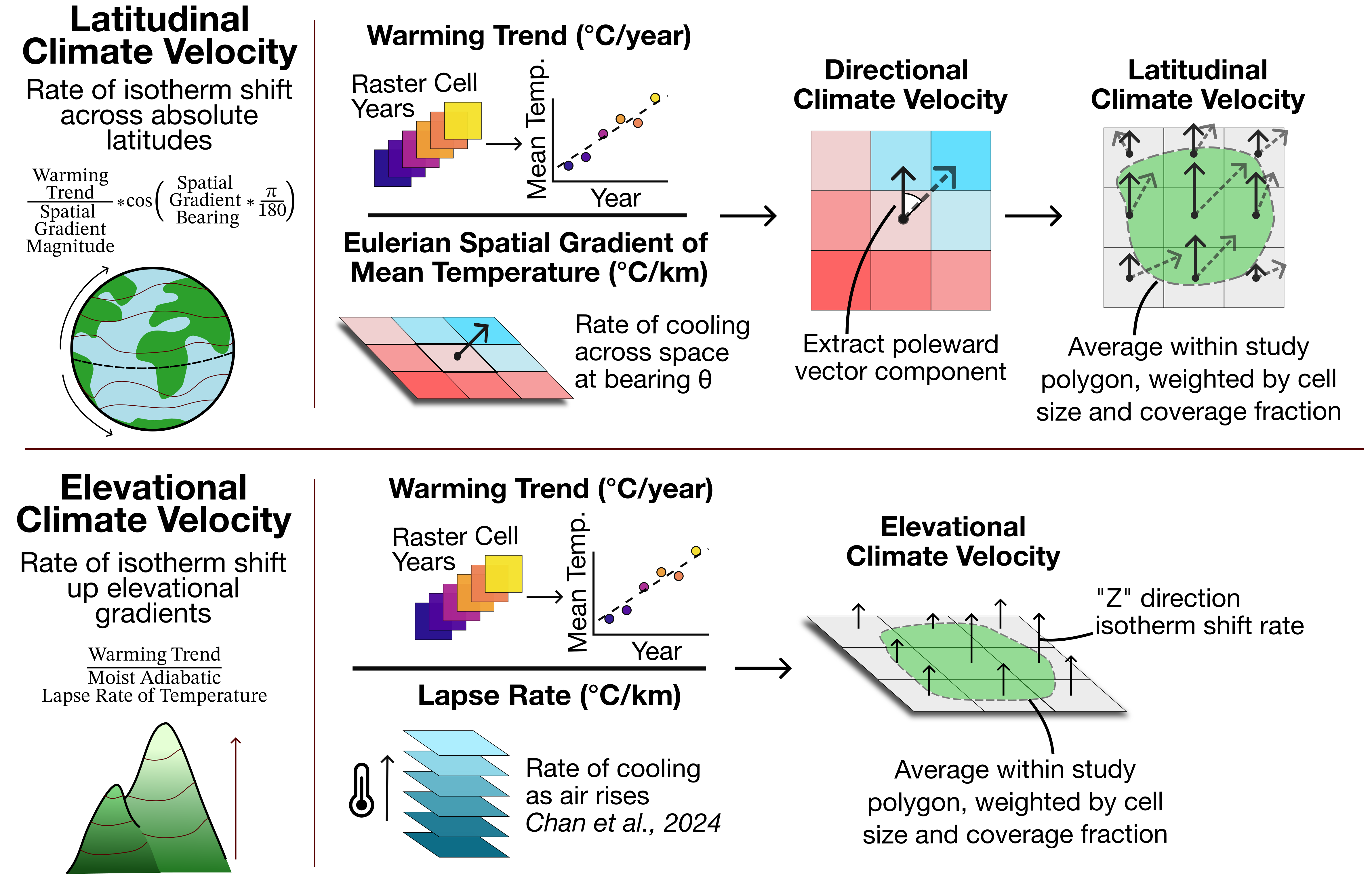
The BioShifts team has standardized calculations for changes in temperature within the geographical regions in which range shifts were recorded (hereafter, study areas), and, when available, the overlapping sections of study areas and known distribution ranges of individual species (hereafter, species-specific study areas). Within each study area and species-specific study area, we provide baseline temperatures over study durations, average trends (°C/year) in temperature over the study period, and the spatial velocity of climate change across latitudinal or elevational gradients (matching the gradient of each associated range shift).
All climate data can be supplemented to selected range shifts with
the add_baselines(), add_trends(), and
add_cv() functions.
Understanding Resolutions
Climate data originate from annual satellite-derived temperature layers spanning to 1912 for terrestrial regions, and 1946 for marine regions, and coarsened to four different spatial resolutions: 1km (for elevation shifts only), 25km, 50km, and 110km grid cells. Summary statistics calculated between the four different resolutions may vary in several ways, so we allow users the option to access data from whichever resolution they feel is appropriate.
These four resolutions offer different trade-offs, because they affect both the variability of climate variables between grid cells (small resolutions will vary more, especially in heterogeneous environments), but they will also affect velocities, since climate velocity is calculated as change in temperature divided by the spatial gradient of environmental values. Larger grid cells will generally result in flatter (smaller) spatial variability in temperature values, decreasing the denominators of climate velocity, and therefore resulting in larger velocity values, compared to climate velocity calculated between small grid cells.
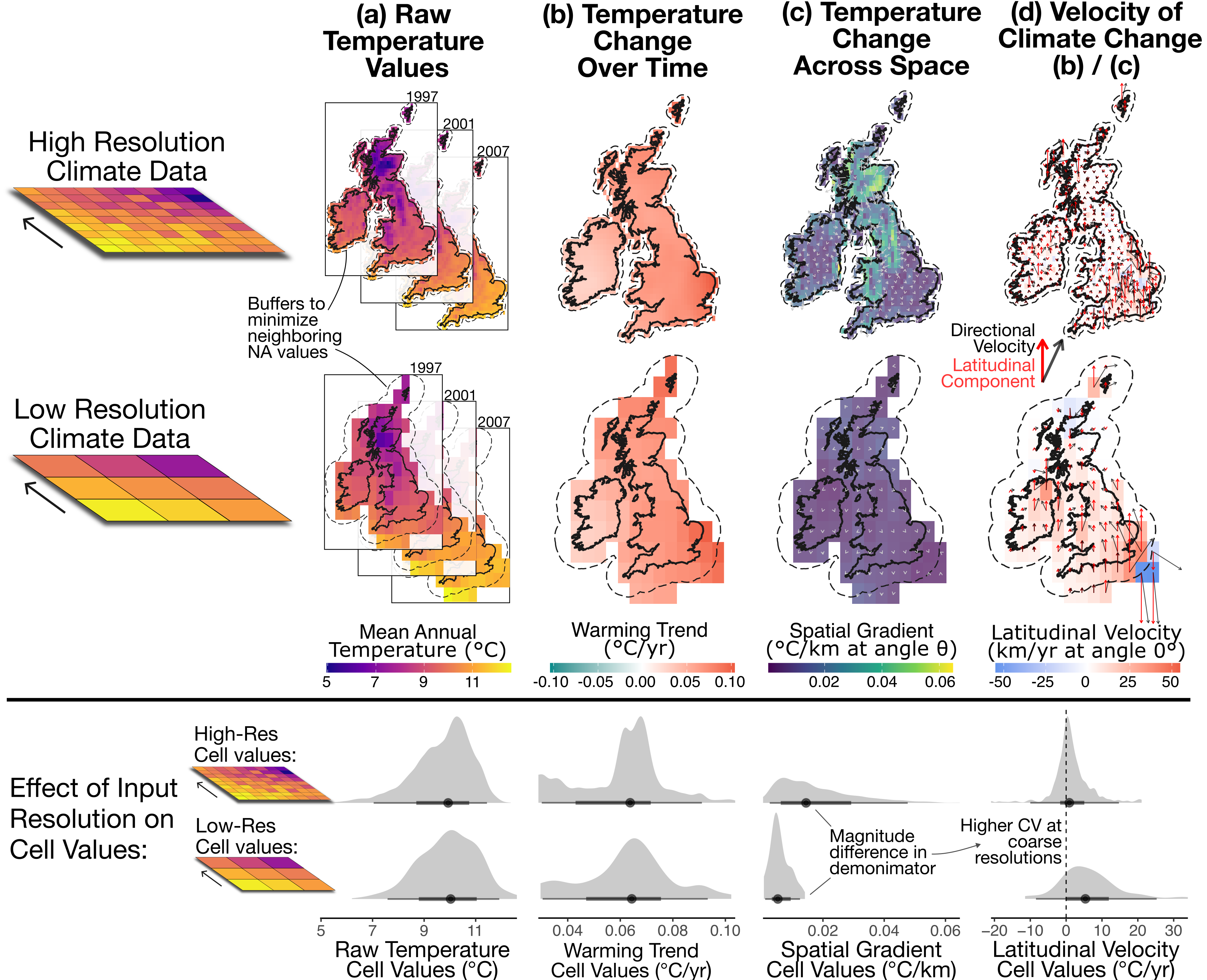
Therefore, climate velocity values calculated at increasing input data resolutions will usually exhibit a gradient of increasing values. These represent both the statistical realities of calculating spatial information from multiple resolutions of data, but may also be useful for pinpointing effects experienced by species, since species of different sizes and mobility characteristics might interact with their environments at different scales.